Yesterday I sat down with a young lady, an AnkGanit student who had come to me with a peculiar query. She said she did not understand what to look for in a mock test Analysis despite our detailed inputs on Analysis. That set me thinking and I realized for most non engineers who have not gone through the rigors of JEE/ AIEEE coaching, objective tests and their analysis would be an alien beast. Hence this blogpost.
Broadly errors in mock tests can be classified into 3 Categories of which 1 Category has two sub categories
All these errors have different remedies and require different approaches.
Let us begin by understanding the first type Selection or Choice Errors.
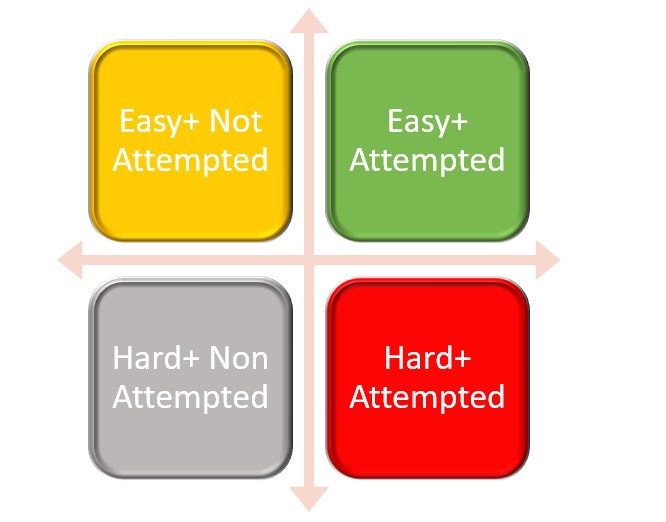
As is apparent, a good candidate should have attempted most or all of the easy questions. Even more important is Not attempting the Hard questions.
After each test, you should map each test across these 4 quadrants. For example, if you are getting attempting Hard questions and leaving Easy questions this simple means that you need to improve your Selection Strategy.
Solution: This problem is a bit like learning any skill. The more you do of it, the better you become. Thus once you are down 15 full length mocks and have mapped all questions into 4 quadrants you will have an idea which questions to select and which ones to let be.
2. Timing Errors: These are the second most common errors. These happen when you spend either more time than required on a question/set or less time than required. You need to track the timer for each question in this type of analysis. For instance let us say a student read an RC and solved the first question in just 3-4 minutes this clearly means the student did not comprehend the RC and was rushing in a panic. Similarly someone who spends 4 minutes on a Parajumble question is being unwise.
Solution: Some suggested times are below. Of course for Quant and LR Ankit Sir’s advice may be better. I am taking liberties here with my advice.
3. The Accuracy error.
Ideally accuracy in VARC should be at least 85% and for Quant and DILR at least 90%. If you have a lower accuracy than this you need to improve it. There could be 2 causes for low accuracy.
1. The first are Concentration or Focus Errors: If you got easy questions wrong that is a clear sign of a Focus Error. Think of the easy DI questions you got wrong. Clearly a Focus error.
Solution: The best remedy for the same is to build your concentration. There are multiple ways to do the same. Throwing away your mobile isn’t necessary. However, keeping it aside during the test definitely is necessary. Also read more about how to build focus via yoga, meditation and deep breathing. Frankly I do none of those yet I manage to focus. How? Think of a date with a person you cherish. Would you be distracted or 100% there? Obviously you would be 100% there. Similarly for 2 hours the mock test needs to be your date. You should be like a horse with blinkers. The unfortunate reality is that with most of us our commitment is not there 100% to the test and we end up suffering. If you can see the mock test and nothing but the mock test like Arjuna for those two hours these errors will be avoided
2. Conceptual Errors: These happen when you don’t know the concept behind the question you got wrong. If you are making conceptual errors at this stage that is most worrisome.
Solution: At this stage of preparation (October mid) trying to do the entire syllabus again would be unwise. If your concepts are weak even at this stage then it will be wiser to reduce the topics you want to learn concepts of to the bare minimum. Ideally you should have learnt the concepts over your 4-12 month journey at AnkGanit but if you have not then it is wiser to focus on core topics. A few new things can be learnt even at this stage. But trying to learn too much will be counterproductive.
Lastly, the first step towards improvement is to identify what kind of errors you are making in mock tests. If you are able to categorize your errors into any of the above 4 categories and follow the solution, you are definitely looking at a 15-40 marks improvement in your score depending on where you are in your preparation journey!